
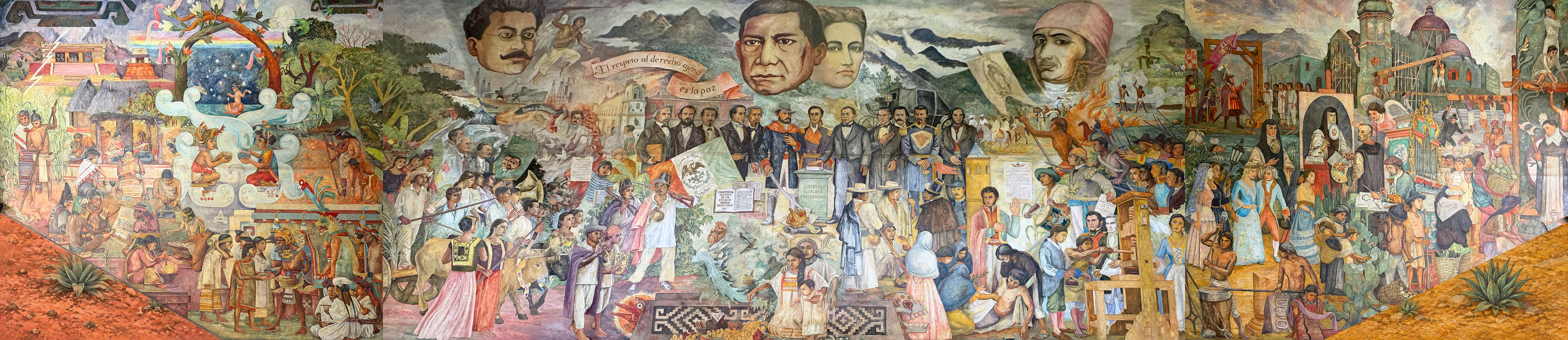
Left wall
Pre-Columbian Oaxaca: origin stories, agriculture, artisanship, codices, and ceremonial life.
Art · memory · public history
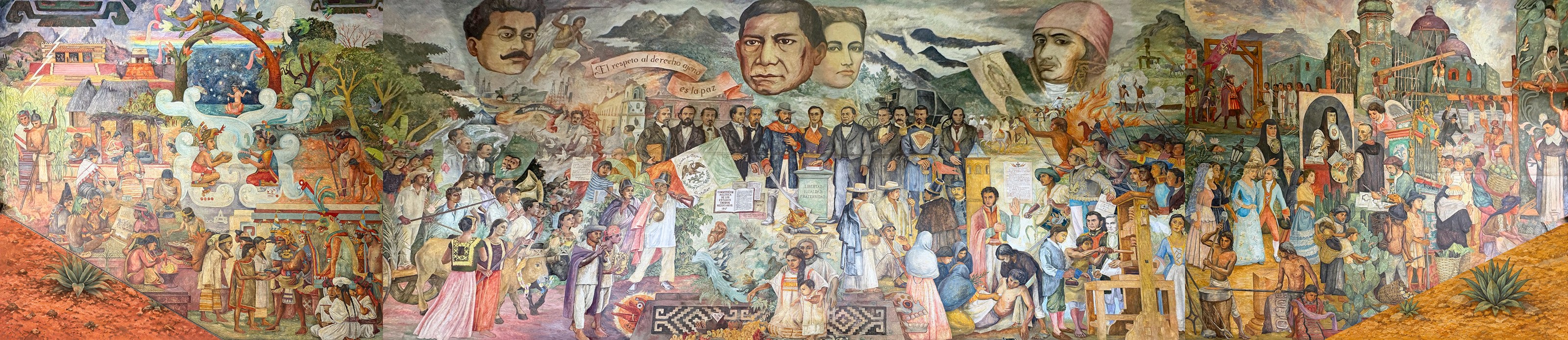
Arturo García Bustos turned three walls of the Government Palace staircase into a 220-square-meter account of Oaxaca—from Indigenous origins and colonial transformation to Independence, Reform, and Revolution.
Full panorama
What the mural means
The mural joins regional history with national political struggles. Its central argument is carried by three monumental heads—Morelos, Juárez, and Flores Magón—while hundreds of workers, artisans, women, Indigenous people, soldiers, musicians, and families show how those eras were lived.
The Government of Oaxaca describes the palace murals as a way to encounter traditions, cosmology, and customs that have endured in the state’s communities. The detailed interpretation below follows historian John Lear’s study published by INAH.
A visual guide
Pre-Columbian Oaxaca: origin stories, agriculture, artisanship, codices, and ceremonial life.
National history seen from Oaxaca: Independence, Liberal Reform, resistance to French intervention, and Revolution.
The colonial period: conquest, evangelization, forced labor, the arts, trade, cochineal, and social life.
People identified in the painting
These are figures specifically identified in the INAH study. Many other painted people represent communities, occupations, and historical groups rather than named individuals.
The large head at the upper left of the central wall introduces the Independence cycle. Morelos brought the independence campaign to Oaxaca and occupied the city in 1812.
At the center, Juárez and the phrase “Respect for the rights of others is peace” anchor the Reform and the defense of the Republic against French intervention.
The upper-right head represents the Oaxacan anarchist whose radical ideas became a precursor to the Mexican Revolution.
Her severed head refers to Oaxaca de Juárez’s civic emblem and links Zapotec and Mixtec stories of conflict, reconciliation, and Indigenous continuity.
The mural gives named women visible roles: Margarita Maza de Juárez, poet Sor Juana Inés de la Cruz, and Francisca Flores, identified in the INAH study as founder of Oaxaca’s first press.
The Oaxacan painter appears making a posthumous portrait of Sor Juana while an angel guides his brush—a deliberately imaginative scene noted by the INAH study.
A young, dissatisfied Porfirio Díaz signals divisions among victorious liberals. José Vasconcelos is the most recent named historical figure in the composition.
García Bustos placed his wife, artist Rina Lazo, and their daughter, Rina García Lazo, walking through the colonial zócalo.
Look again
The three staircase walls reorganize time: pre-Columbian Oaxaca at left, national history in the center, and the colonial period at right.
Leaders and ideals occupy the upper register, events and notable people fill the middle, and ordinary people and daily life run across the lower edge.
Santa Anna’s severed leg and Maximilian’s fallen crown stand for conservative and imperial defeat without turning the composition into a row of portraits.
Mixtec goldworkers and codex painters, forced cathedral labor, cochineal production, artisans, market workers, and musicians make daily life the mural’s strongest continuous thread.
At the lower level, Oaxacans follow a traditional band toward the staircase, creating the impression that the painted procession will continue into the city.
Named historical women appear alongside artisans and Tehuanas, giving women a presence in political, cultural, and everyday history.
Verified sources
* A note about the date: INAH’s monument record says García Bustos painted the mural in 1979, while INAH’s scholarly article identifies the completed work as 1980. A 2023 Government of Oaxaca visitor page gives 1989. We retain the difference here rather than silently choosing one official date.
John Lear’s detailed study of the mural, its figures, symbols, structure, and historical context.
Open the official source ↗Official monument record for the Government Palace of Oaxaca and the staircase mural.
Open the official source ↗Official visitor description of the palace murals and the periods represented.
Open the official source ↗Source material is published in Spanish. English explanations on this page are translations and concise summaries prepared by Oaxaca en Utah; links always lead to the original official text.
Explore more cultural images →